Funeral-home death-certificate requirement
The CallerThe Funeral-home death-certificate requirement is the procedural safeguard that a funeral home must have a death certificate before beginning its work. In the attempt to arrange a false funeral pickup at the home of Helge Landmark, that requirement gives the employees a concrete basis to question a caller’s claim and makes the difference between an expected death and a certified one consequential.
The Requirement and Its Routine
Arnesen explains that the funeral home cannot begin its work without a death certificate. Doctors often send certificates by post, he says, so the requirement is compatible with ordinary professional practice: a certificate need not arrive in person, but it must exist before the funeral home proceeds. The distinction is important. A caller’s report, even one framed as a doctor’s notification, does not itself satisfy the formal condition.
The Landmark Call
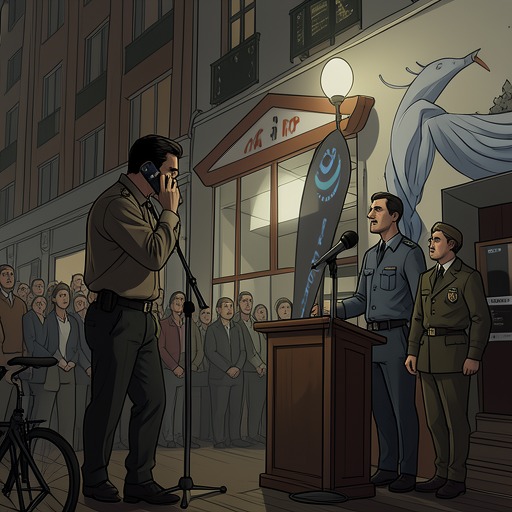
A man calling himself Dr Mikkelsen gives Arnesen the Landmark address and says Helge has been ill for a long time and that his death was expected. When Arnesen asks for the certificate, the caller agrees to send it by post. The promised document lends the story the appearance of routine, but it is still only a promise; the caller has not supplied the proof the funeral home requires. Arnesen later judges the situation a mistake on every conceivable level, and the incident is reported without delay.
Procedure Meets the False Pickup
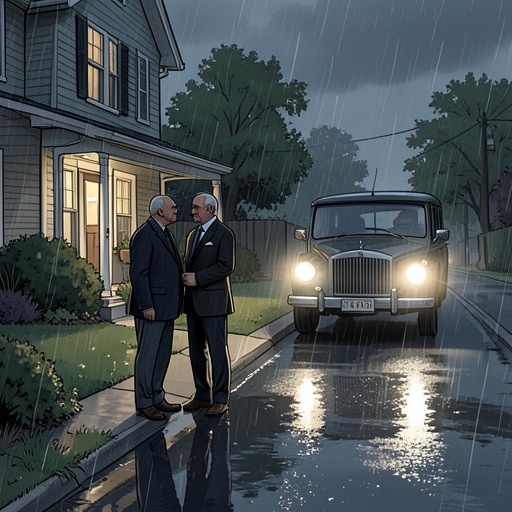
The safeguard does not prevent the deception from reaching the Landmark home. Arnesen and his colleague Knoop are there, and Helge, still alive, looks at the car and asks whether a reservation can be made. The contrast is stark: the call has represented his death as expected, while his question treats the vehicle as a service he might use in the future. The scene brings the rule’s central distinction into view without making the certificate itself a complete defense against a fabricated report: procedure supplies a point of verification, but the false claim has already set events in motion.
Significance
The requirement places death within an administrative process rather than leaving it to assertion alone. In this episode, the caller imitates the language of medical certainty and offers to post the required document; the funeral home’s rule makes that missing document matter. The episode’s unease comes from the distance between a claim that sounds professionally plausible and the living person at the address, whose presence exposes what the paperwork has not established.